How Drone Building Cleaning Works
Tethered hoses, ground pumps, soft-wash chemistry and pilots on the ground — a plain-English walkthrough of a drone cleaning job.
The kit
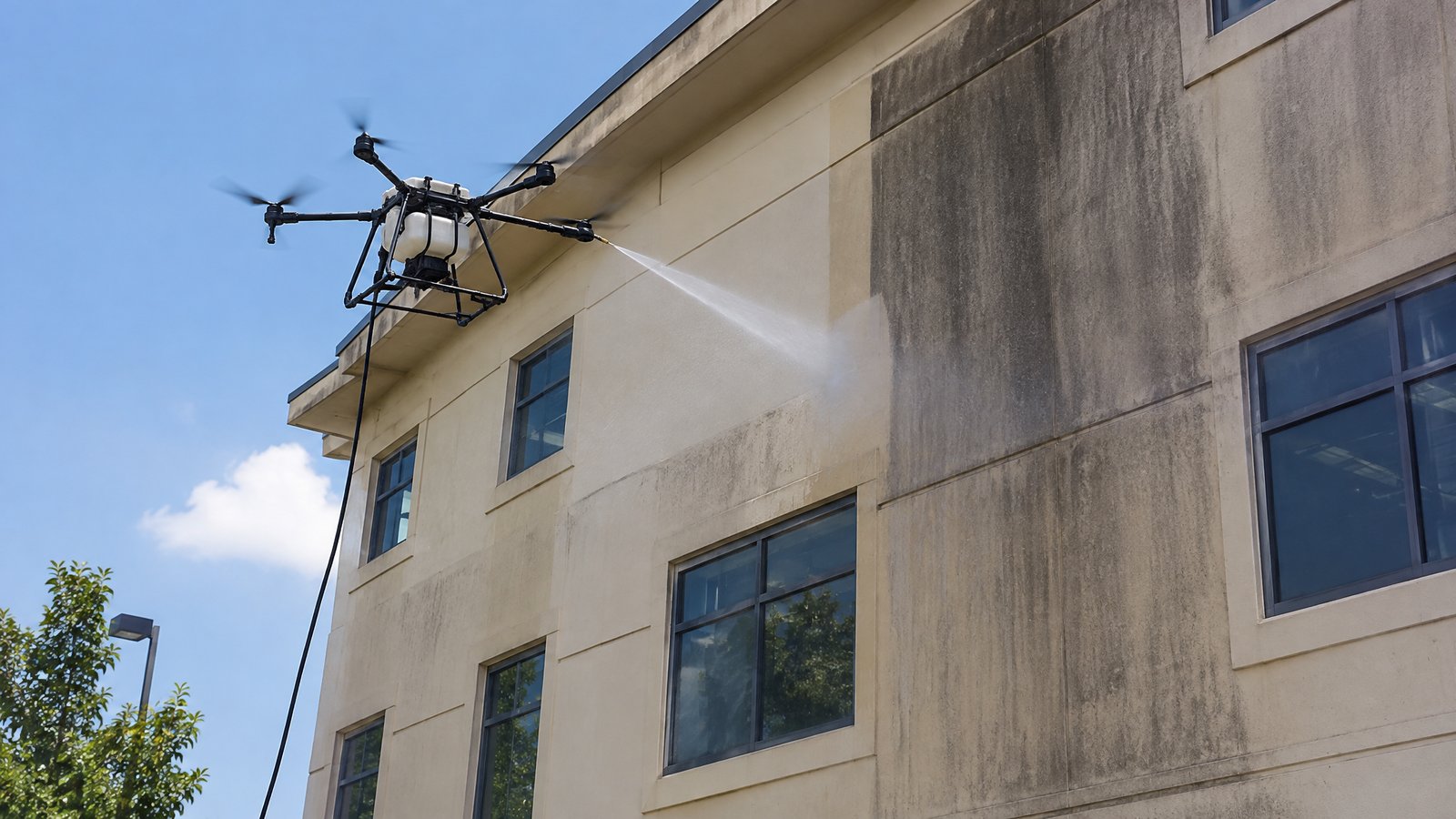
Most cleaning drones are heavy-lift multirotors fed by a tethered hose from a ground pump and water tank. Some use a power tether so the drone can stay up for hours rather than minutes. The spray payload may be a soft-wash nozzle, a pressure lance, a pure-water brush or a foam or coating applicator.
On the day
The crew surveys the site, sets an exclusion zone below the work area, checks wind, protects plants and vehicles, and mixes the cleaning solution. The drone then works the building in passes — applying detergent or algaecide, allowing dwell time and rinsing — while the pilot stays on the ground with a visual observer.
Reach and speed
Leading platforms are marketed with working heights of around 150–195 ft and coverage of up to about 300 sq ft per minute. Real-world speed depends on the surface, the soiling and the chemistry, so ask for references on buildings like yours.
Limits
Drones are not ideal for every job: very high winds, tight urban canyons, heavy embedded grime that needs scrubbing, and sites near airports or crowds can limit or rule out a drone. Good providers will tell you when a lift or rope-access crew is the better option.
Ready to compare providers?
Describe your project once and get quotes from suitable drone cleaning companys.